Features of this site
This site is built with SvelteKit and uses Pandoc to convert LaTeX articles to HTML at build time. Here is what is available.
Math
Inline math works with dollar signs. For example, the quadratic formula is and Euler’s identity is .
Display math uses double dollars:
The cross-entropy loss commonly used in NLP:
Code
Code blocks use verbatim environments:
import torch
import torch.nn as nn

class Transformer(nn.Module):
    def __init__(self, d_model: int, nhead: int):
        super().__init__()
        self.attention = nn.MultiheadAttention(d_model, nhead)
        self.norm = nn.LayerNorm(d_model)

    def forward(self, x: torch.Tensor) -> torch.Tensor:
        attn_out, _ = self.attention(x, x, x)
        return self.norm(x + attn_out)
Inline code uses texttt, like
const x = 42.
Images
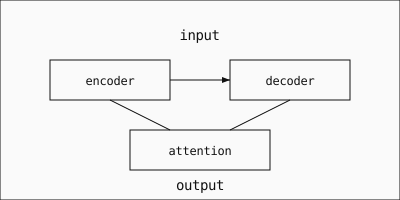
Articles can include images from their assets/ folder.
The build script copies them to
static/articles/<slug>/ so they are served as static
files.
Citations
Each article can have its own refs.bib file. Pandoc
processes citations automatically via –citeproc.
The Transformer architecture [1] revolutionized natural language processing. For foundational algorithms, see Knuth [2].
Typography
Regular text uses Cascadia Mono. Bold and italic work as expected.
Blockquotes are rendered from the quote environment.
Lists work too:
First item
Second item
Third item
Publications
Site-wide publications are loaded from a BibTeX file
(content/refs.bib) and rendered on the publications page.
Article-specific references are kept in each article’s own
refs.bib.